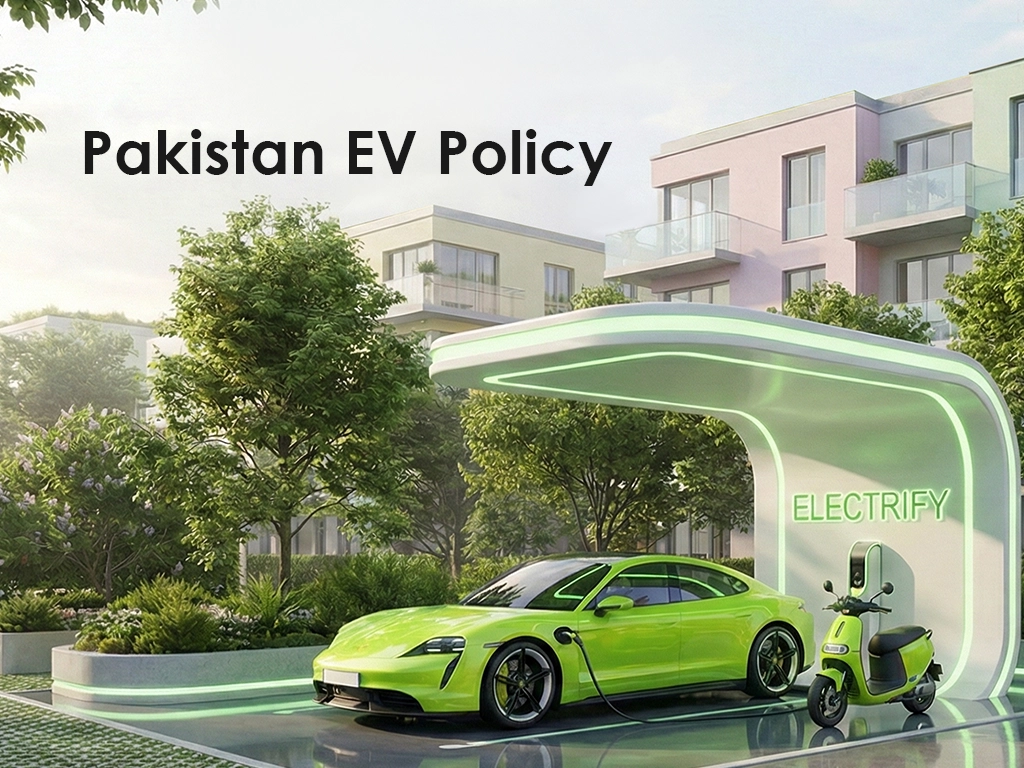
The government of Pakistan has taken a bold step toward sustainable transportation and a greener future by launching the National Electric Vehicle Policy 2025–30. This policy sometimes referred to simply as EV policy Pakistan aims to transform how people and goods move across the country, reduce dependence on imported fuels, improve air quality, and grow domestic industry.
In this post, we’ll break down what the EV policy is, why it matters, what incentives it offers, and what it could mean for everyday people across Pakistan including riders, manufacturers, and urban residents.
Why Pakistan Needs an EV Policy
Transportation is a major contributor to air pollution, fuel imports, and greenhouse-gas emissions in Pakistan. With growing vehicle use in cities and towns, traditional petrol and diesel vehicles contribute heavily to smog, carbon emissions, and health risks.
By shifting toward electric vehicles (EVs), Pakistan has the opportunity to cut fuel consumption, reduce pollution, and lessen dependence on foreign oil. The EV policy is not just about cars, it’s about environmental sustainability, public health, and laying foundations for a local EV industry.
Key Goals and Targets of the EV Policy Pakistan
Some of the main targets and ambitions under the policy include:
- 30% of all new vehicles sold by 2030 should be electric.
- Over time, EV adoption is expected to help save 2.07 billion liters of fuel annually, translating into nearly USD 1 billion in foreign exchange savings.
- The shift to EVs is projected to reduce carbon emissions by 4.5 million tons per year, lowering air pollution and greenhouse-gas emissions.
- Health-related savings are also estimated to be substantial: lower pollution could result in reduced respiratory and pollution-linked diseases, decreasing annual health-related costs by approximately USD 405 million.
Over the long term, the policy aims to build a domestic EV manufacturing ecosystem from two and three-wheelers to four-wheelers and possibly larger commercial vehicles boosting local industry, employment, and technological capacity.
What the Policy Offers — Incentives & Support
To make EV adoption viable and attractive, the EV policy includes a wide range of incentives and structural support. Here are the key components:
Subsidies for Consumers
- The government has allocated Rs 9 billion in subsidies for the fiscal year 2025–26, earmarked for helping deploy 116,053 electric bikes and 3,171 electric rickshaws.
- Notably, 25% of the subsidy quota is reserved for women, aiming to provide inclusive, safe, and eco-friendly mobility for female riders.
- In addition to bikes and rickshaws (two- and three-wheelers), the policy extends to four-wheelers and even commercial vehicles, though incentives differ based on vehicle class.
Support for Local Manufacturing & Industry
- The policy offers customs-duty reductions, tax breaks, and sales-tax concessions for EV parts and locally assembled vehicles, to encourage domestic production.
- Special support will be given to small and medium enterprises (SMEs) and local manufacturers to deepen “localization” of EV parts and vehicle assembly.
- The policy envisions building an EV supply-chain ecosystem from batteries and motors to charging-infrastructure, maintenance, and manufacturing facilities which could spur “green jobs” and industrial growth.
Charging Infrastructure & Ease of Use
A major hurdle for EV adoption has always been “range anxiety” and lack of charging facilities. The EV policy addresses this by:
- Planning to install 40 fast-charging stations on motorways, with an average spacing of 105 kilometres between them.
- Introducing battery-swapping systems, vehicle-to-grid (V2G) schemes, and requiring EV-charging points in new building codes meaning new residential or commercial developments must consider EV-charging infrastructure.
- Offering incentives / support for setting up public and private charging stations including for businesses willing to install chargers.
What It Means for Ordinary Citizens & Everyday Use
For Riders and Small Transport Users
If you ride a bike or rickshaw, or rely on such vehicles for daily commute, the EV policy could make a big difference:
- Lower running cost: Electric bikes/rickshaws cost significantly less to ‘fuel’ (electricity vs petrol/diesel). With subsidies, the upfront cost becomes more manageable.
- Faster return on investment: Given low charging costs and subsidies, many users could recover the extra upfront cost within a couple of years.
- Cleaner, quieter ride: Less air pollution and noise, especially in congested urban areas.
For Urban Residents & Public Health
- Reduced air pollution fewer petrol/diesel vehicles means better air quality, especially in cities. This could reduce respiratory illnesses and related health problems.
- Health cost savings at both individual and public level due to cleaner air.
For Industry, Entrepreneurs & Investors
- Opportunities for local businesses: assembly plants, spare-parts manufacturing, battery production, maintenance workshops, charging-station infrastructure, etc.
- New jobs and “green-economy” growth in a sector that previously had little footprint locally.
Reduced import dependency: lower fuel imports, reduced strain on foreign exchange reserves beneficial for national economy.
Challenges & What Needs Attention
While the EV policy is promising, success depends heavily on careful implementation and overcoming certain risks / limitations:
- Charging infrastructure rollout needs to be timely and widespread without sufficient public/private charging stations, EV adoption will remain limited.
- Electricity supply & grid capacity increased demand for electricity must be met reliably; load shedding or unstable supply may discourage EV usage.
- Battery disposal / recycling & environmental safeguards with many EV batteries coming into use, a plan for disposal or recycling should accompany manufacturing and usage.
- Affordability beyond incentives even with subsidies, the upfront cost of EVs (especially four-wheelers) may remain high for many. Continuous incentives, financing, and awareness will be needed.
- Coordination between government, private sector, and consumers policy success depends on all stakeholders working together: regulators, manufacturers, infrastructure providers, and citizens.
The Road Ahead — What to Watch in Next Few Years
As the EV policy rolls out, these are the developments to watch:
- Growth in local manufacturing of EVs and components, more local assembly plants, battery manufacturing, spare-parts supply.
- Expansion of charging infrastructure, public stations, fast chargers on highways, battery-swap and V2G systems, charging at residential/commercial buildings.
- Increasing EV adoption among everyday riders particularly bikes, scooters, rickshaws driven by subsidies, lower running cost, and rising awareness.
- Emergence of green-jobs and EV-related services maintenance workshops, charging-station operators, battery-recycling centers, etc.
- Gradual shift in transport habits, more people opting for EVs over ICE (internal-combustion engine) vehicles, contributing to cleaner air and sustainable transport.
Conclusion
The National Electric Vehicle Policy 2025–30 marks a significant milestone for Pakistan’s transport sector. With clear targets like 30% of new vehicles being electric by 2030, strong incentives for consumers and local industry, and a roadmap for charging infrastructure and manufacturing, the policy has the potential to reshape mobility, reduce pollution, and build a sustainable EV ecosystem.
For citizens, it could mean affordable, cleaner rides; for businesses, new opportunities; for the country, reduced fuel imports and stronger energy security. Naturally, challenges remain infrastructure, electricity supply, cost, implementation but if managed well, this EV policy could very well kick-start a green transport revolution in Pakistan.