A growing number of Pakistanis are switching to electric vehicles (EVs) due to increased petrol prices. But, how much does it cost to charge an EV? To truly understand this question, you need to understand the EV tariff. In the following article, we will break things down to allow you to understand the EV charging costs in Pakistan.
EV tariff is the cost you incur based on the units (kWh) of energy you consume while charging your EV, hence, similar to your household electricity bill, however, rates may differ in EV charging in certain circumstances.
In Pakistan, the EV tariff is partly governed by the state, namely, the electricity supply companies, and the operators of the charging stations.
In Pakistan, the National Electric Power Regulatory Authority (NEPRA) is the authority that governs all electricity supply and pricing. NEPRA EV Tariff is regulatory in nature and provides pricing for electricity supply to promote usage of EVs by offering attractive rates. Presently:
To encourage the adoption of electric vehicles nationwide, the government intends to keep the EV tariff affordable.
Charging your electric vehicle (EV) comes with a cost, the EV charging tariff. This cost is determined by the rate per unit of electricity. This rate can change depending on where you’re charging your EV.
Charging at home is usually the least expensive option since you will be using your own electricity.
Charging here is a little more EV charging tariff than home charging because they factor in the cost of running the station and any services provided.
These stations charge the most. This is primarily due to the expense that goes into the infrastructure needed for very rapid charging. However, in most instances, it will still be less expensive than fueling with petrol.
EV charging tariff is something to learn about so you can charge your EV in the most cost-effective way.
The EV Unit Price in Pakistan varies depending on your electricity provider and your status (commercial, industrial, residential, etc.).
EV charging rates in Pakistan differ based on charging stations, and that’s why it’s broken down as follows:
For residential charging stations, EV charging rate Pakistan are typically cheaper, and for commercial stations, rates are a little higher. Fast chargers charge the most. Regardless of the charging station, the EV charging rates in Pakistan are relatively affordable in comparison with the distances travelled in a day.
The EV charging rate per unit in Pakistan is based on the rates measured in kilowatts per hour (kWh). 1 unit of electricity is equivalent to 1 kWh. To put this in numbers:
EV Charging costs per kWh is particularly relevant for determining total expenses on electric vehicles. In Pakistan, charging costs per kWh vary from PKR 65 to 94 depending on location and type of chargers within the country.
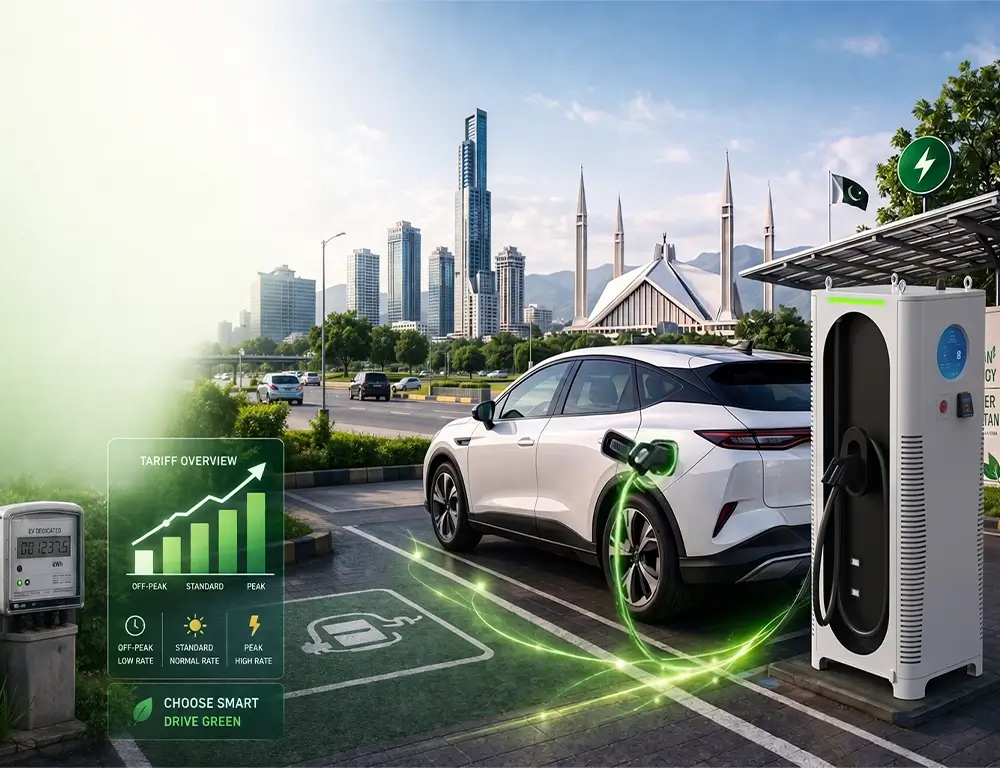
The above image illustrates the potential of the EV tariff facilities that EVs can offer in terms of saving money for customers in Pakistan. For example, let’s look at one simple comparison:
Type | Monthly Cost (Approx. 1,000 km) |
Petrol Car | PKR 27,000 – 53,000 |
EV (based on EV tariff) | PKR 12,000 – 17,000 |
Several components determine the EV tariff:
Policies regarding subsidies and charge/price regulations may modify the price.
The rates for different DISCOs may vary.
Cost varies depending on fast or slow charging.
During peak and off-peak hours of the day the rates may vary for charging. All of the above factors can help you control the EV tariff in a better way.
You can save money on EV charging by:
Tips above will help you save money on charging at night because of an EV tariff.
EVs are very new in Pakistan and charging infrastructure is also developing. The government is setting up:
In the near future, the government is planning to keep changing the EV tariff and charging points.
In Pakistan, for every possible EV owner, understanding EV tariff is very essential. There are many different terms related to EVs, charging, and power costs, which are very useful in determining how to spend while using an EV.
EVs are a great option given the recent infrastructure development and power costs. Keeping up to date with the EV tariff correlates to spending less and being more eco-friendly.
The EV tariff is anywhere between PKR 65 and 94 per charge kWh depending on the charging type and charging station location.
The EV charging cost per kWh is determined by taking the battery size of the vehicle (in kWh) and multiplying it with the cost of electricity per unit (kWh).
Yes, on a per-kilometer rate, the NEPRA EV tariff makes EV charging far less expensive than gasoline.
According to your power level, the typical EV charging rate in Pakistan for residential charging is around PKR 65 per unit.